

MEMORY LIVES
IN FAMILIES
Every family carries fragments of history — photographs, letters, documents, objects, and stories passed from one generation to another.
These personal memories reveal what official records often leave out: how repression, deportation, imprisonment, war, and displacement were experienced by individual people and families.
We preserve these stories so that private memory becomes part of our shared history.

IDA SHCHUPAK
Toronto, Canada
“What would have happened to me
if the children had found out that I was
the daughter of an ‘enemy of the people’?”

ELENA RESSIN
Daughter of a victim of Stalinist repression Toronto, Canada · Born in Moscow, USSR
“They told me I had to renounce my father. I said, ‘Then I would rather not join the Komsomol. I will never renounce my father.’
My mother never forgave them. Neither did I.”

FATHER NESTOR MIKHAILETCHKO
Family history of Soviet deportation
Toronto, Canada · Ukrainian Carpathian roots
“They came at night. You could take thirty kilograms with you — some clothes, some food, and nothing more. People died along the way, especially children and the elderly. They were buried under the railway embankment, and the train moved on.”


MARAT RESSIN
Family history of Stalinist repression
Toronto, Canada · GULAG and exile across generations
“They were ground down physically, but not morally. They went through years and decades of camps and were never broken.”
VITALIY KOLODNY
Grandson of a victim of Stalinist repression
Toronto, Canada · Kharkiv & Kryvyi Rih, Ukraine
“I never thought the GULAG would touch my own family. My grandfather was arrested in 1937. Whenever I asked him about it, he refused to talk.”

ZINAIDA SHEVCHENKO
Local historian and community activist
Khmelove, Kirovohrad Region, Ukraine
“Our task is to document and preserve the memory of a past that was silenced under the Soviet regime.”

VOLODYMYR KOLOT
Grandson of Kyrylo Davydovych Kolot
Executed in Bykivnia near Kyiv in 1937
“Even though my grandfather was branded an ‘enemy of the people,’
the whole family fought — for the USSR, as they used to say, for Stalin.”


MYKOLA BENDIUK
Artist-restorer · Head of the Art Cluster, Ostroh Academy · Rivne, Ukraine
“From generation to generation, my family fought for an independent Ukraine. My mother was left an orphan at the age of three.”
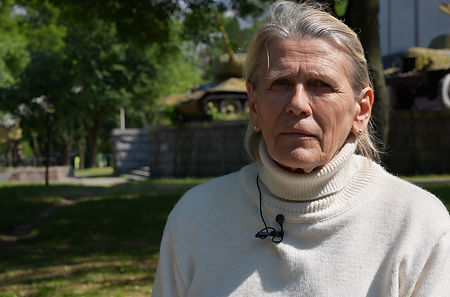
VALENTYNA VLASENKO
Family memory of the Holodomor
Dnipro, Ukraine
“He was swollen from hunger, and he didn’t get up again until he died.” For decades, families carried memories like this in silence.

MARTA HRYTSIAK & TARAS ROMANIUK
Daughter and grandson of Yevhen Hrytsiak
Ustia, Kolomyia District, Ukraine
“The uprisings in Norilsk, Vorkuta,
and Kengir were, in fact, the beginning of the end of the Soviet system. The struggle for Ukraine’s freedom continues across generations.”

VASYL DUDKO
Born into a family deported by the Soviet authorities · Dnipro, Ukraine
“Sixty-eight families were forcibly relocated from our village. My parents were deported to the Far East, and I was born in a camp in Amur Oblast.”

EDUARD ANDRUSHCHENKO
Historian · Author of KGB Archives: True Stories
Kyiv, Ukraine
“The repressions of the 1930s were not about logic, but about fear and chaos. The KGB conducted surveillance before arrests — using eavesdropping, photographs, and informants.”

DMYTRO SYNYTSIA
Retired rural teacher · Born in Vorkuta
Dnipro, Ukraine
“My father told me, ‘Your real birthday is the day Stalin died.’ I was born in a prison hospital in Vorkuta and learned the truth only as an adult.”

IVAN DREMLYUGA
Head of the Regional Society of Political Prisoners and Repressed · Dnipro, Ukraine
“It is essential to speak about repression, remember it, and draw conclusions from our past. Without its own state, a nation cannot survive.”


OLENA LEGOSTAYEVA & KALERIYA POPOVA
State Archive of the Dnipropetrovsk Region
Dnipro, Ukraine
“Files contain not only information, but also a heavy human energy. Each case preserves a personal tragedy that still demands to be remembered.”

DMYTRO KARAN
Chaplain of the Armed Forces of Ukraine
Kyiv, Ukraine
“This war is existential: if we have no right to exist, then we must defend not only our land, but our very identity.”